

We love a nice round number.
It feels official. Scientific. Safe.
10,000 steps.
10,000 hours.
Two metrics that have taken on mythic status.
But here’s the thing:
Neither was ever meant to be a rule.
10,000 Steps Was a Marketing Campaign
Not a medical breakthrough.
The 10,000-step goal didn’t come from a scientific study.
It came from a 1965 marketing campaign in Japan—designed to sell pedometers.
It stuck.
Because it was clean. Easy to remember.
But not evidence-based.
The real research tells a different story.
In a 2019 study published in JAMA Internal Medicine, mortality risk dropped steadily as step count increased—from 2,000 to around 7,500 per day.
But beyond that?
No significant benefit. The curve flattened.
That means 7,500 steps is the sweet spot—for most of us, especially as we age.
Less than 5,000? Too little to move the needle.
More than 7,500? Not a bad thing—just no proven upside.
But there’s a deeper truth most people miss.
The health benefits weren’t just about the number.
They came from how people lived.
People who got those steps didn’t cram them into one power walk and then sit for ten hours.
They moved throughout their day.
They lived in bodies that were used often—not just exercised occasionally.
10,000 Hours? Same Story.
It’s not the number. It’s how you use it.
Yes, Anders Ericsson—the psychologist who studied elite performance—did mention 10,000 hours.
But only as an average, observed in one specific group:
Violinists at a prestigious music academy in Berlin.
The top performers didn’t just practice more.
They practiced differently.
They broke down weaknesses.
Trained at the edge of their ability.
Rested with purpose.
Used feedback loops.
Made their training uncomfortable—on purpose.
That’s what Ericsson called deliberate practice.
He later clarified, directly:
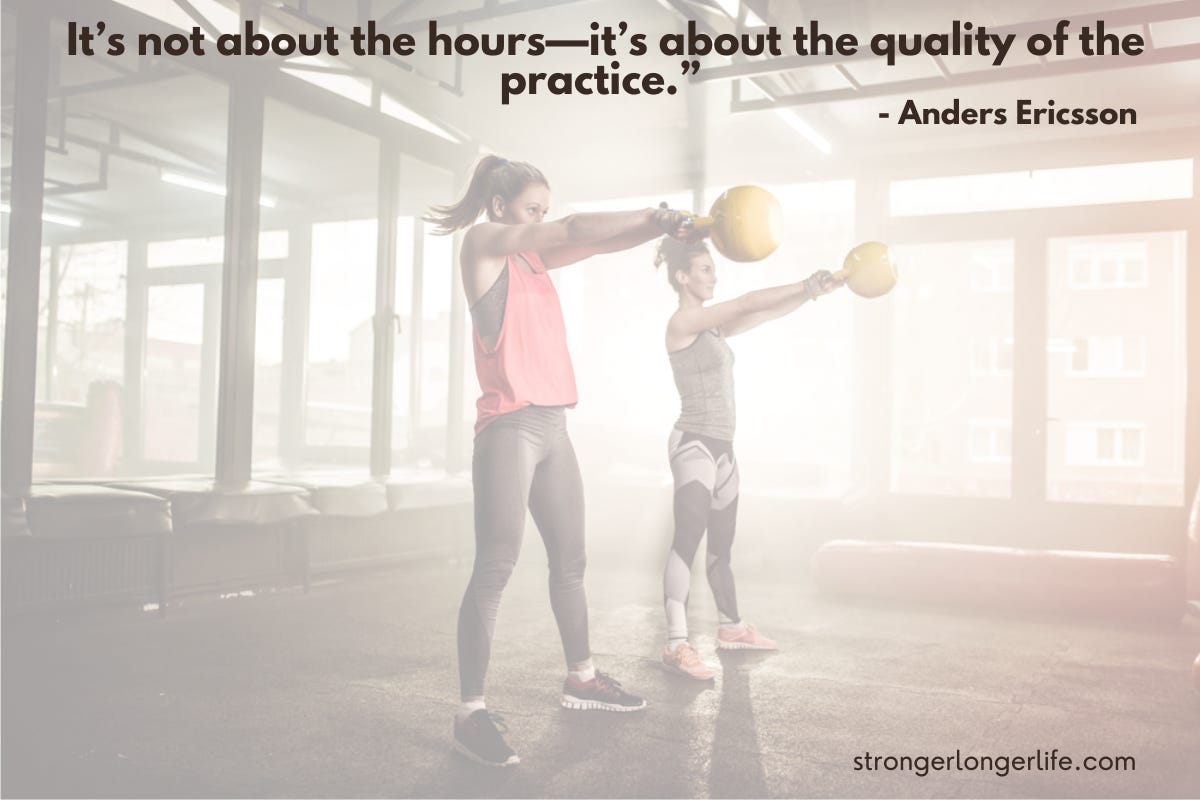
“Gladwell created a catchy phrase, but it’s a misinterpretation.
It’s not about the hours—it’s about the quality of the practice.”
Tony Robbins said something similar:
“Do you have 20 years of experience,
or one year of experience repeated 20 times?”
Both Robbins and Ericsson highlight the same thing:
Quality and intentionality in practice are what lead to excellence.
It’s not the quantity of time or steps,
but the purposeful effort within that time that makes the difference.
What Actually Works?
A physical practice—built on purpose.
This is the part most people skip.
They chase numbers.
Buy programs.
Download PDFs from people who don’t know them.
And wonder why it doesn’t stick.
But here’s the truth:
A physical practice isn’t something you stumble into.
It doesn’t happen by accident.
It’s not a hack.
It’s something you build. Intentionally.
With clarity. With care.
With incremental steps over time.
It’s not one-size-fits-all.
It’s shaped by your body, your life, your season.
And it evolves with you.
You don’t just do it.
You live it.
And the outcomes you want—strength, confidence, energy, capacity?
They show up as byproducts.
This is the real shortcut.
It just doesn’t look like one.
Because when you stop chasing intensity and start building consistency,
when you stop copying and start recalibrating,
the results feel natural.
Inevitable.
Sustainable.
This is what it means to live stronger, longer.
Not to push harder for quick wins.
But to invest wisely in the one thing that never stops paying you back:
A physical practice, built on purpose.
Here’s 3 Steps to Build a Physical Practice That Lasts
1. Define What Stronger Means to You
Forget someone else’s metrics.
Do you want to hike longer? Golf better? Play tennis? Stay sharp?
Your practice should serve your life—not a fantasy physique or a viral trend.
2. Start Small, But Make It Intentional
Skip the “go big or go home” mindset.
Add movement throughout your day.
Train with purpose, not just effort.
3. Focus on Rhythm Over Rules
You don’t need 10,000 steps or 10,000 hours.
Create a rhythm you can return to—on your best days, and your worst.
One that fits your season, respects your body, and adapts with you.
Here for the second half -
Jeff
P.S.
The story most people believe about getting fit—grind harder, eat less, chase perfection—is the very thing keeping them stuck.
There’s a different story?
One built on rhythm, not rigidity.
On strength, not struggle.
A physical practice that fits your life—instead of demanding you fit into someone else’s program.
If you’re ready to live stronger, longer—on your terms—I’m here for the conversation.
Real talk about what’s possible in your second half. Hit reply—I’m excited to hear your story.
I love this Jeff! As a food blogger focused on making healthy eating attainable and sustainable, I have learned that sticking to your goals is more about the daily habits and progress that comes from it than striving for perfection only to fall short and stop trying.
Love this myth-busting!! Thank you for the insight - it makes a ton of sense and now I feel less "guilty" when I have a 8,000 step day :)